.png)
Weekly Snapshot
- BTC: US $76,000 (+4.5%)
- ETH: US $2,340 (+5.2%)
- Crypto Market Cap: US $2.56T (+5.5%)
- Gold: US $4,868/oz (+0.8%)
- S&P 500: 7,126 (+4.5%)
- ASX 200: 8,947 (-0.3%)
Executive Summary
- Bitcoin spiked above US $78,000 on Friday after Iran reopened the Strait of Hormuz and oil crashed 13%, before Iran reclosed the strait late Saturday in response to Trump maintaining the US naval blockade, with IRGC gunboats firing on tankers and BTC retracing to around US $76,000.
- Bitcoin developers published BIP-361, a proposal to freeze roughly 5.6 million dormant BTC, including Satoshi Nakamoto's ~1.1 million coins, ahead of a future quantum computing threat, igniting Bitcoin's sharpest governance debate in years.
- The CLARITY Act's long-awaited Senate Banking Committee markup is now contingent on a three-point checklist from Chairman Tim Scott, with missing the April window potentially pushing US crypto market structure legislation past 2030.
The Hormuz Whipsaw
On Friday 17 April, Iran's Foreign Minister declared the Strait of Hormuz "completely open" for commercial vessels for the remainder of the Lebanon ceasefire. Oil prices fell from above US $90 per barrel to below US $80, the largest single-day decline in weeks. Bitcoin broke above US $78,000 following ~US $593 million in short liquidations.
Bitcoin and Oil Whipsawing on Hormuz Re-Opening & Closing
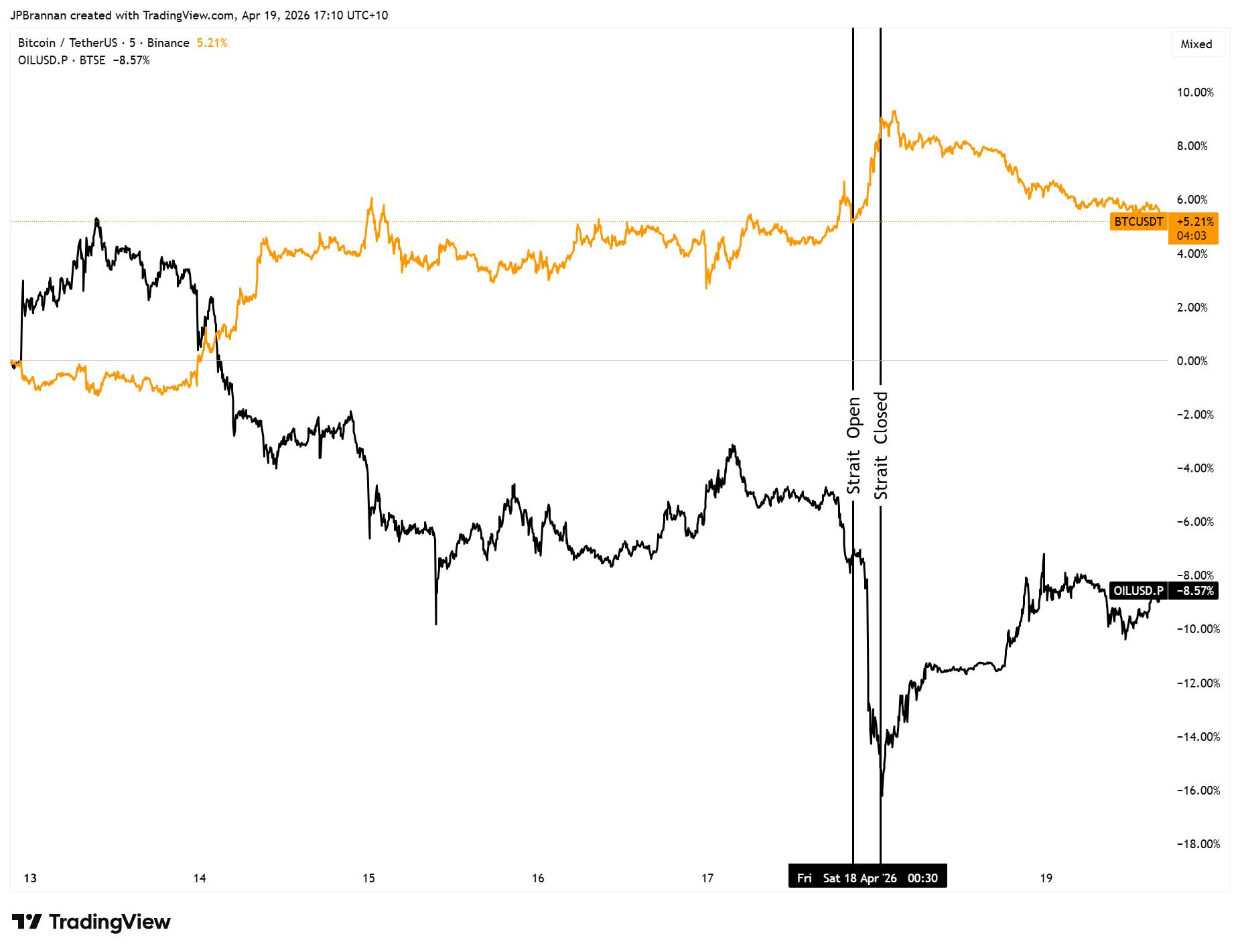
The move did not survive the weekend. After Trump confirmed the US naval blockade on Iranian ports would remain in force due to several other conditions not being met. Iran's Revolutionary Guard navy reclosed the strait on Saturday evening and has since opened fire on an India-flagged supertanker. It's believed that the U.S. still wants Iran to make concessions on its nuclear program, and for free access to the Strait without the tolls that the Iranian regime has begun charging for safe transit through.
Implications for investors
We're viewing implications across two time frames. Near-term, the oil-energy crisis increases inflation, pushing prices higher and reducing chances of interest rate cuts. These conditions are not stimulative to digital assets and we expect continued choppy sideways momentum with potential pullbacks if the situation continues for an extended period. Longer-term, the conflict which costs billions of dollars daily in additional military spend, reinforces the case for scarce, portable money that isn't subject to inflation or sanctions. Long-term buy and hold is still the best approach in our view.
Bitcoin's Quantum Response
On 14 April, Casa CTO Jameson Lopp and five co-authors published BIP-361, titled "Post Quantum Migration and Legacy Signature Sunset." The proposal outlines a three-phase plan: after an initial migration window, legacy old non-quantum secure addresses would be frozen if they did not move to new quantum-resistant address formats.
Over 34% of circulating bitcoin, roughly 5.6 million coins worth around US $420 billion, sits in addresses with exposed public keys, including approximately 1.1 million BTC attributed to Satoshi Nakamoto. Backlash was immediate, with Blockstream CEO Adam Back countering at Paris Blockchain Week that Bitcoin should adopt optional quantum-resistant features rather than pre-scheduled freezes.
Watch this video if you want to get up to speed on quantum computing and understand the risks to bitcoin and other blockchains:

Implications for investors
This is the first time a serious technical proposal has directly threatened Bitcoin's "not your keys, not your coins" foundation. Markets have so far treated it a foregone future upgrade rather than a near-term threat. We still view the upgrade as the most likely outcome and a positive one to ensure the long-term security of the network. Bitcoiner's that may find out their bitcoin was frozen, will also be able to unfreeze if they can prove ownership of the keys.
Clarity Act Almost Across the Line - But Delays Could be Costly
Senate Banking Committee Chairman Tim Scott told Fox Business he has resolved the CLARITY Act down to three outstanding issues: finalising stablecoin yield language, closing out DeFi provisions, and securing Republican unity on the committee.
Scott estimated each of the first two could be resolved within two weeks. The same day, White House crypto adviser Patrick Witt confirmed on X that a stablecoin yield compromise between Senators Tillis and Alsobrooks had been reached, restricting passive yield on idle balances while permitting activity-linked rewards. However, on 17 April, Senator Tillis told Politico he would likely not release the compromise text that week, citing uncertainty over the markup schedule. Galaxy Research has warned that if the Banking Committee fails to clear the bill in April, 2026 passage odds collapse toward zero.
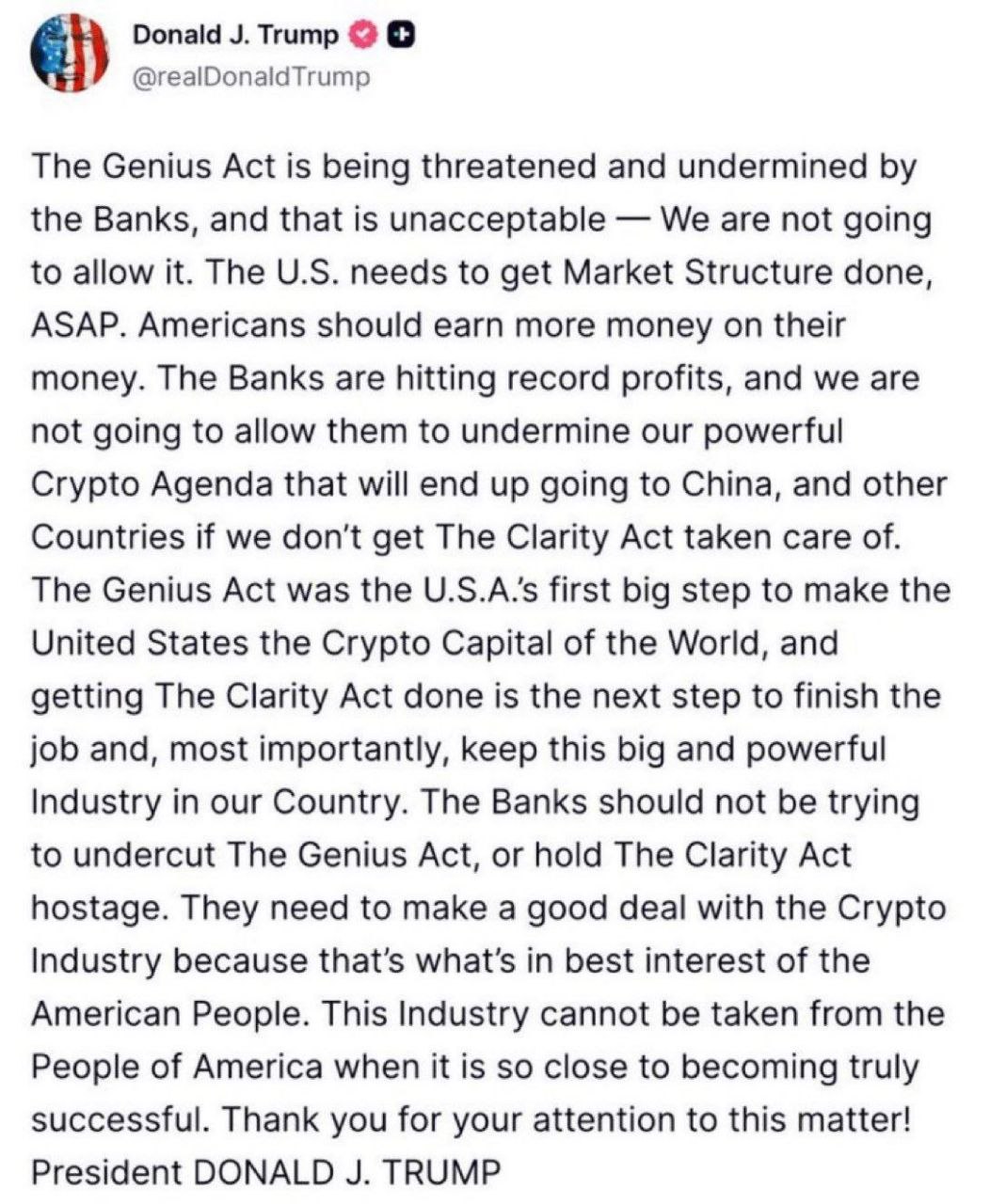
Trump has been a vocal proponent of the CLARITY Act, siding with the crypto industry to provide investors more yield on their deposits.
Implications for investors
The CLARITY Act is the single largest regulatory catalyst currently priced into US crypto equities and infrastructure tokens. Passage would resolve the digital commodity classification for assets like ETH, SOL, and XRP, unlock SEC ETF approval on dozens of pending filings, and provide the legal certainty required for US banks to custody digital assets at scale.
The contrarian take is that the market has been pricing CLARITY Act passage at various probabilities for nearly a year, and each procedural slip has produced underwhelming price responses. If the markup slips to May, exchange tokens and compliant issuers like Circle face a valuation headwind precisely because the legislative window narrows into the midterm cycle. Senator Lummis, who announced her retirement in December 2025, has framed this as the last realistic window before 2030, and that is the timeframe investors should weight against continued delay.
Until next week,
James
Sign up to receive the latest crypto trends, insights, and news.
.png)