.png)
Weekly Snapshot
- BTC: US $67,075 (-2.9%)
- ETH: US $2,017 (-2.8%)
- Crypto Market Cap: US $2.29T (-2.5%)
- Gold: US $4,495/oz (-3.6%)
- S&P 500: 6,368 (-3.4%)
- ASX 200: 8,516 (+0.2%)
Executive Summary
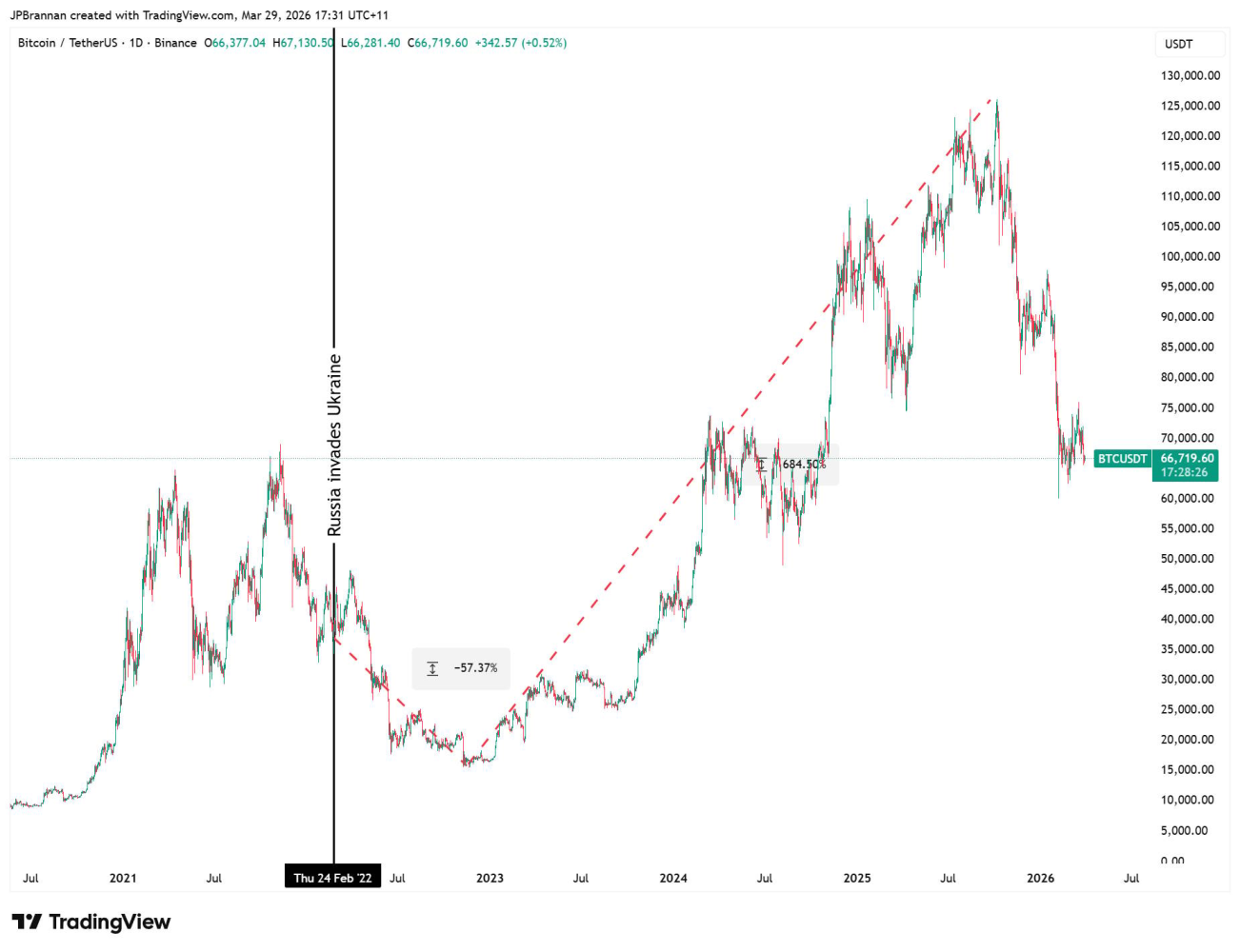
- Bitcoin has remained in a tight range as geopolitical uncertainty persists; already drawdown ~50% before the conflict began. During the beginning of the Russia-Ukraine war, bitcoin fell by 57% over the first 9 months, before rallying over 684% subsequently.
- Fannie Mae has accepted its first crypto-backed mortgage, allowing Americans to pledge bitcoin or USDC as collateral for a home loan down payment without triggering a taxable disposal.
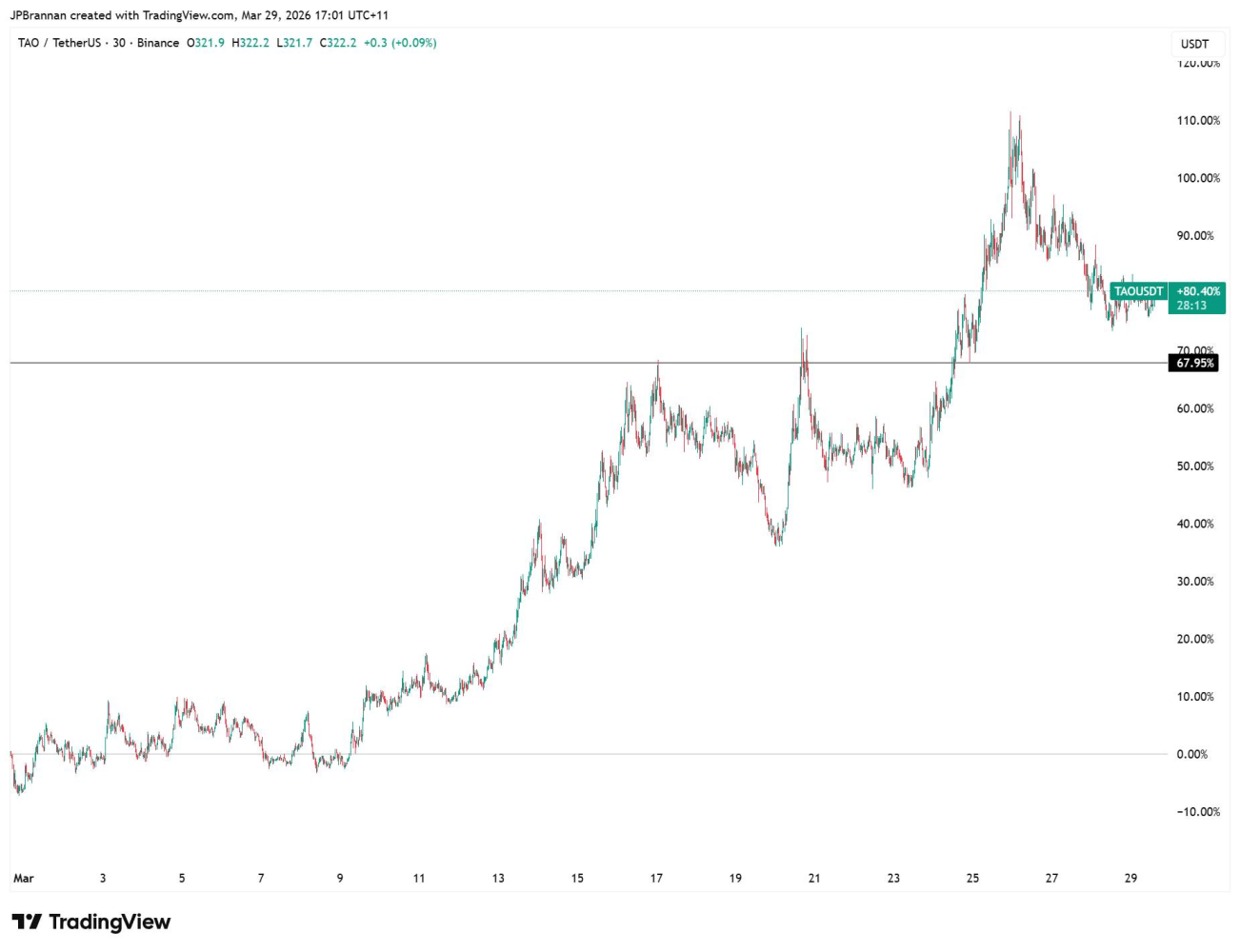
- TAO has surged 80% in one month to US $333, riding the decentralised AI narrative as institutional and retail interest accelerates around the intersection of blockchain and artificial intelligence.
Update on The War & Implications for Bitcoin & Digital Assets
It's been just over a month since the U.S. struck Iran on 28 February. Since then, the market narrative has been firmly focused on the rising oil price (currently US $101/barrel), rising inflation, the prospect of higher interest rates, and both equity and gold markets retracing.
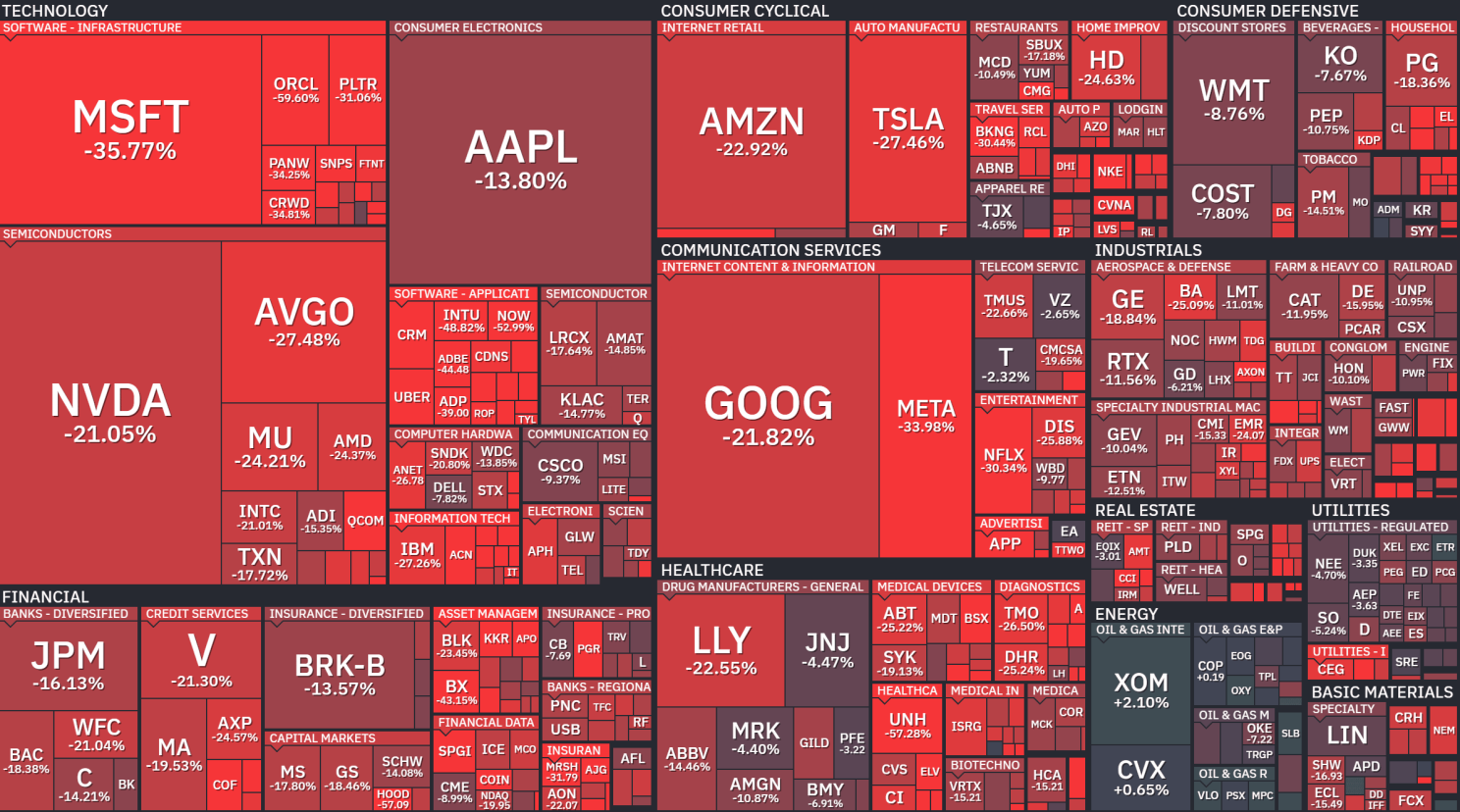
Most of the S&P 500 is in the red from its 52-week high, with many of the large technology names down by more than 20%.
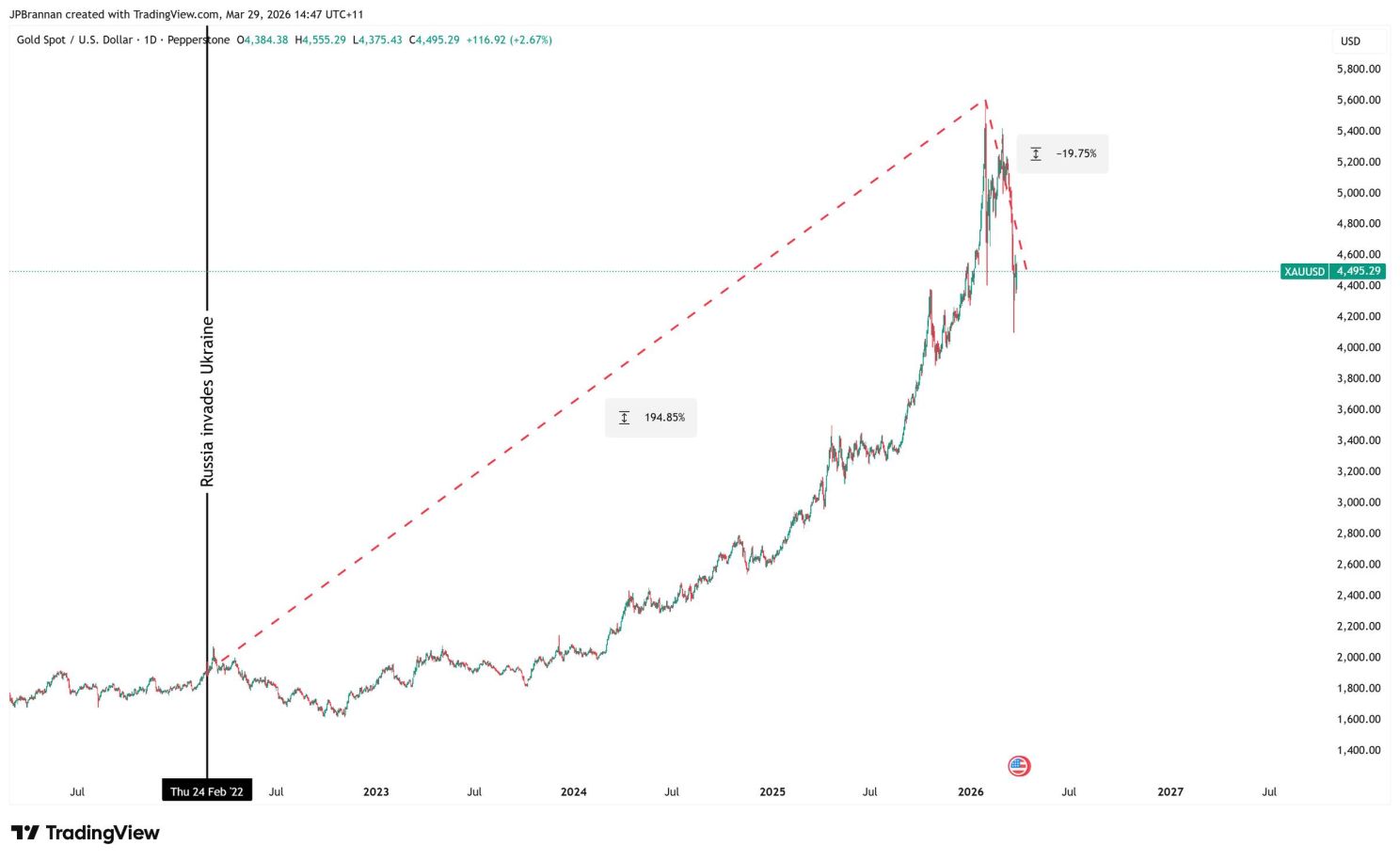
Gold is trailing roughly 20% below its US $5,600 price reached in January and appears to be consolidating following its 194% run-up since the Russia-Ukraine conflict began in February 2022.
For digital asset investors, the question is: where do markets go from here?
Bitcoin had already retraced approximately 50% before the conflict began and has since remained in a sideways range, oscillating between US $65,000 and US $70,000 without a clear break in either direction.
Looking ahead, Secretary of State Marco Rubio stated in his most recent interview that "this is not going to be a prolonged conflict." He reiterated that the U.S.'s goals are to destroy Iran's missile factories, navy and air force to limit future nuclear weapon capabilities.

Despite this, another 3,500 troops were recently deployed to the Middle East to add to the 50,000 already stationed there. The move is purported to give Trump more options should the need arise.
Worth noting is that with the U.S. mid-term elections to determine seats in both the House of Representatives and the Senate around the corner, having rising inflation, higher rates for mortgage holders and a declining stock market is unlikely to help the Republican party maintain control of both branches of government.
Worse still, the conflict appears to be broadening. As of yesterday, Yemen's Houthi movement announced its entry into the Iran war by firing a barrage of ballistic missiles at southern Israel.
Still, we think it is more likely that the U.S. withdraws from the region and calls it a successful intervention, as opposed to risking a prolonged conflict or Iraq 2.0. Rising protests both in the U.S. and abroad against Trump as part of the 'No Kings' movement have seen record crowds in recent days.

Implications for investors
Periods like this are difficult to predict, but history offers some useful reference points.
Bitcoin has typically recovered strongly in the 12 months following major geopolitical shocks. After Russia's invasion of Ukraine in February 2022, bitcoin fell 57% over the following eight months before rallying over 684% in the subsequent 3 years. The S&P 500 followed a similar pattern, bottoming roughly six months after the invasion before recovering to new highs.
Markets also tend to move quickly once de-escalation is announced. If the U.S. pulls back after achieving its stated military objectives, a swift relief rally across risk assets (including crypto) is a plausible scenario.
That said, the inflationary impact is likely to persist. Oil above US $100/barrel flows through to transport, food and energy costs, and those prices rarely snap back even when the underlying commodity corrects. The Fed may be forced to hold rates higher for longer, which would keep pressure on equities and other rate-sensitive assets.
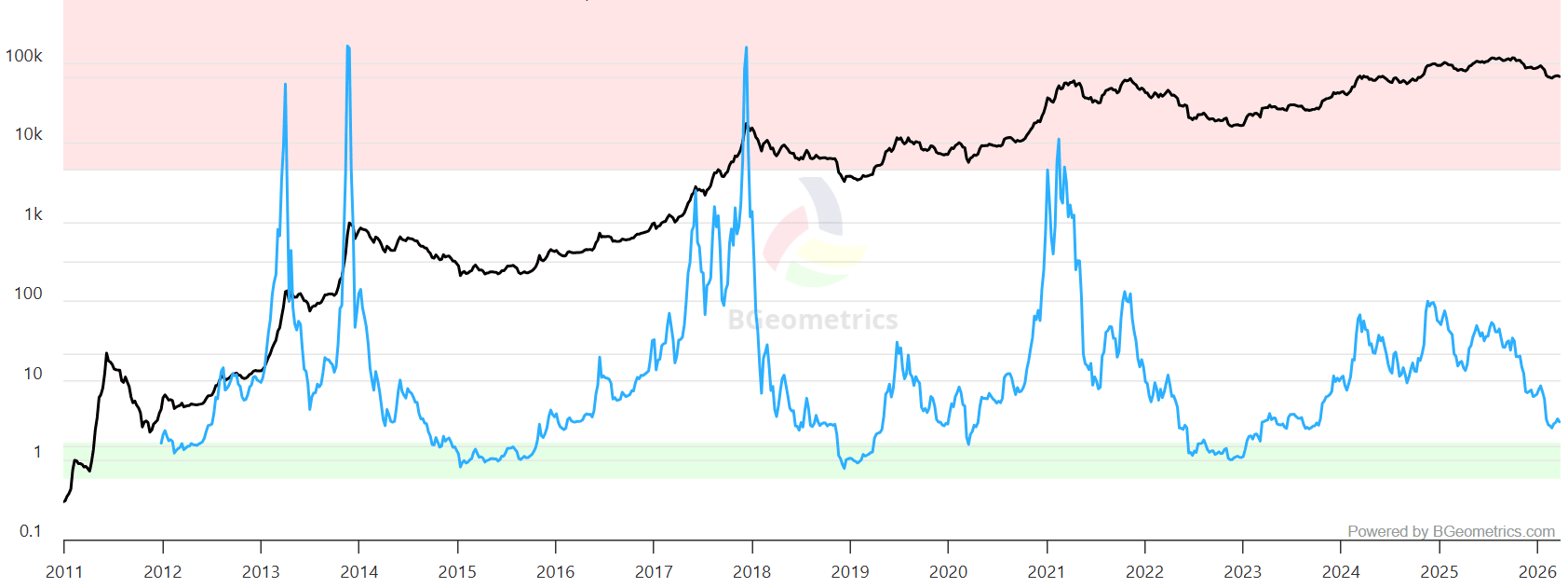
For bitcoin specifically, the setup is worth paying attention to. It is trading at traditionally cheap valuations on the MVRV ratio (blue line) - a metric comparing bitcoin's market value to its realised value.
The challenge for investors is acknowledging that prices can still fall further, while using periods like this to accumulate at a lower average cost.
Fannie Mae Just Accepted Its First Crypto-Backed Mortgage
Americans can now use bitcoin or USD Coin (USDC, a US dollar-pegged stablecoin) as collateral to fund a home loan down payment - without selling their crypto.

The product - built by mortgage company Better Home and Finance in partnership with Coinbase - has now been accepted by Fannie Mae, the government-backed agency that underpins a large portion of the US home loan market, which will purchase those mortgages just like any standard conforming loan.
The structure involves two loans: a regular mortgage plus a second loan backed by crypto, which funds the down payment on the first. The crypto stays locked in custody for the life of the loan and can't be traded, but it's returned once the loan is repaid. On a US $500,000 home, a borrower could pledge US $250,000 in bitcoin to secure a US $100,000 down payment loan.
Implications for Investors
This is a significant step that a major bank is now using bitcoin as collateral - it signalls a no going back type moment for the industry. For the first time, crypto holders can access homeownership without triggering a taxable disposal of their assets. It also signals how quickly the line between digital assets and traditional financial products is blurring. Ethereum and Solana may be added as eligible collateral down the track, which widens the addressable market considerably.
TAO Surges 80% In 1 Month on AI Narrative
Over the last month, TAO has surged by more than 80% to reach US $333, flipping its market cap above World Liberty Financial. The token continues to gain notoriety as it provides AI training models access to distributed and more cost-effective compute.
Early investor Jason Calacanis continued to publicly double down, posting simply "TAO > $BTC" to his followers.
Bittensor (the underlying network) uses a "proof of useful work" model - rather than rewarding miners for raw computing power as Bitcoin does, it rewards AI model outputs, positioning TAO at the intersection of blockchain and decentralised artificial intelligence.
Implications for Investors
TAO is being positioned as more than a token - it's a bet on decentralised AI infrastructure at a moment when the world is questioning who controls artificial intelligence. The comparison to early Bitcoin is doing a lot of heavy lifting in this narrative, but the underlying structure - fixed supply, fair launch, no VC allocation - gives it credibility that many AI-adjacent tokens lack. The next halving is projected for late 2029, which would cut inflation again to around 6.25% - a deflationary event, structurally the same as Bitcoin's halving cycle.
Until next week,
James
Sign up to receive the latest crypto trends, insights, and news.
.png)