.png)
Weekly Snapshot
BTC: US $89,100 (-6.6%)
ETH: US $2,941 (-11.1%)
Crypto Market Cap: US $2.97T (-6.9%)
Gold: US $4,988/oz (+8.0%)
S&P 500: 6,916 (-0.7%)
ASX 200: 8,860 (+0.1%)
Executive Summary
- The Netherlands parliament advances controversial legislation to tax unrealised capital gains on stocks, crypto and bonds from 2028, sparking concerns about capital flight and highlighting the growing case for self-custody, crypto and borderless wealth.
- Bitcoin and crypto markets demonstrated resilience through geopolitical volatility as President Trump's European tariffs were suspended after a framework deal on Greenland, rewarding investors who deployed the "TACO trade" strategy.
- ARK Invest's Cathie Wood believes Bitcoin has likely bottomed in this cycle with the shallowest drawdown in history at approximately 30%, as institutional adoption disrupts traditional four-year halving cycles.
Key Stories this Week
Why Crypto May Become the Vehicle to Protect Your Wealth
On 20 January, a majority of parliamentarians in the Netherlands prepared to vote in favour of modifying annual income tax filings to include a tax on capital gains, covering both realised and unrealised gains regardless of whether investments have been liquidated - NL Times.

The proposed legislation, targeting implementation by 2028, would apply to stocks, bonds and cryptocurrencies, whilst real estate investors would receive more favourable treatment with deductions for costs and taxation largely upon realisation.
This policy represents more than a local Dutch tax reform - it's a canary in the coalmine for global wealth taxation trends. The Netherlands isn't alone in this trajectory. Similar patterns have emerged elsewhere: California has experienced significant wealth migration as high earners relocate to tax-friendly jurisdictions; France's wealth taxes proved economically unproductive, driving capital overseas; and Australian politicians recently tried, and failed - thankfully, to implement unrealised capital gains taxation on superannuation balances exceeding A$3 million.
For digital asset investors, this underscores several critical realities. First, self-custody becomes not just a security measure but a sovereignty tool. Second, the borderless nature of cryptocurrency enables capital to flow to jurisdictions that respect property rights - Singapore, Switzerland, the UAE and others compete aggressively for crypto wealth with zero capital gains taxation or more reasonable frameworks. Third, this validates Bitcoin's core value proposition as unconfiscatable, censorship-resistant wealth that transcends jurisdictional boundaries.
For investors, geographical diversification and understanding the tax implications of residency choices have never been more important. The message is clear: jurisdictions that overreach on taxation will lose both capital and innovation to more accommodating competitors.
The TACO Trade Delivers Again
US President Donald Trump announced he would not impose tariffs on eight European nations scheduled to take effect on 1 February, citing progress in talks with NATO Secretary-General Mark Rutte on Greenland according to euronews.
The reversal came after Trump threatened to hit those countries with new tariffs starting at 10% next month and increasing to 25% in June - CNBC.
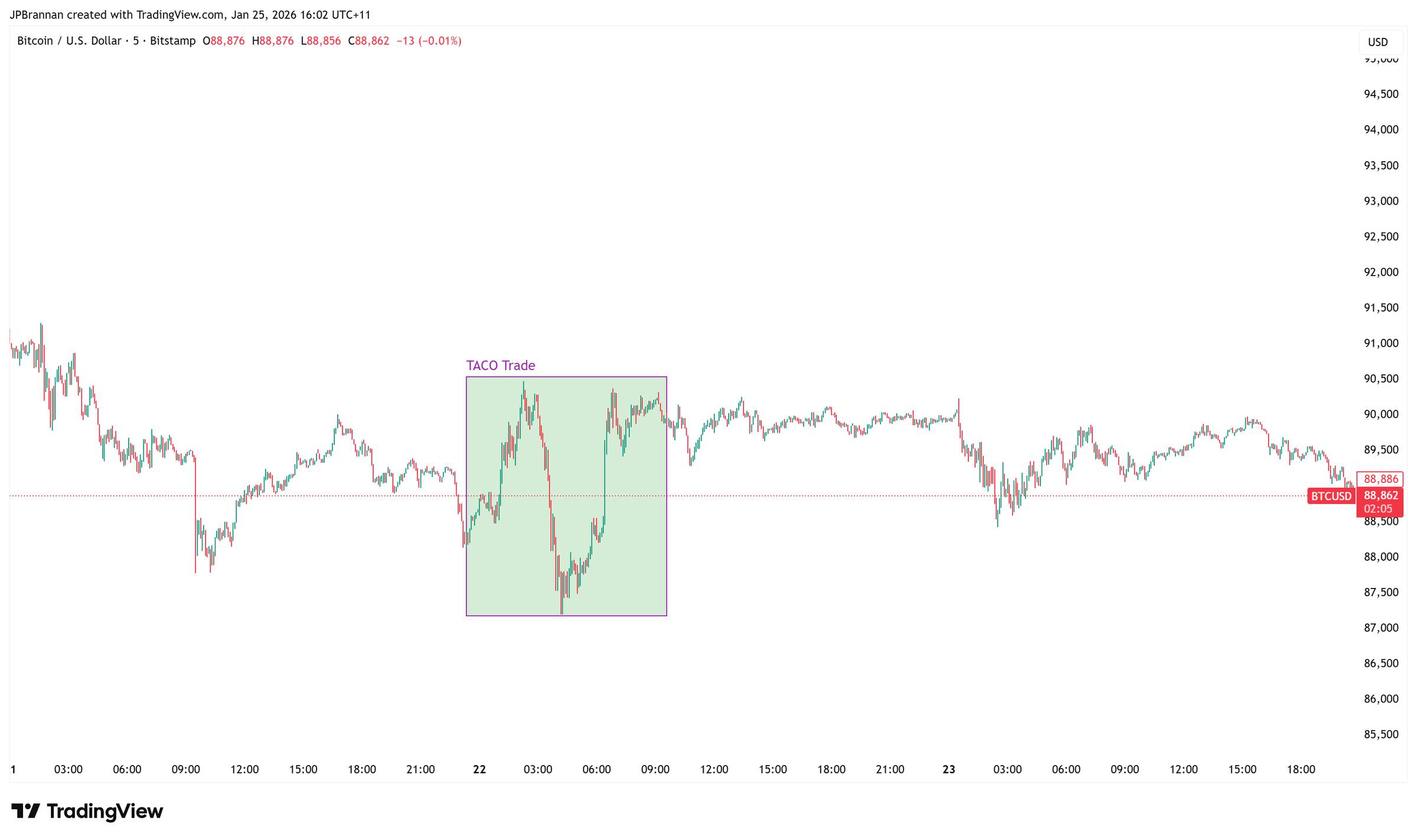
The sharp policy U-turn triggered immediate market reactions. Bitcoin, which had briefly dipped to US $87,000 earlier in the week, reversed sharply to trade back above US $90,000. US equities rose, whilst gold, which had rallied to record highs above US $4,950 per ounce on safe-haven flows during the uncertainty, maintained elevated levels.
The speed and magnitude of the reversal vindicated investors deploying what markets have termed the "TACO trade" - Trump Always Chickens Out - buying the dips on tariff threats before eventual policy reversals.
The pattern of tariff theatre followed by policy reversal creates both opportunities and risks for digital asset investors. On one level, it generates predictable volatility that can be exploited. Bitcoin's correlation with macro risk sentiment means these episodes create buying opportunities for those with conviction and capital. The US $87,000-US $90,000 range demonstrated strong support, suggesting institutional bidders remain active at these levels.
Cathie Wood: Bitcoin Cycle Bottom Is In Shallowest Drawdown in History
ARK Invest CEO Cathie Wood declared that Bitcoin has likely reached the bottom of its latest downturn, arguing that the current cycle has been unusually mild and that broader economic forces are turning supportive for risk assets.
Skip to 9 min 39 sec for Cathie's take on the bitcoin market:

Speaking to CNBC, Wood stated: "We may test in this US $80,000 to US $90,000 range on Bitcoin, but we do think that the test will be successful".
The current drawdown from Bitcoin's all-time high of approximately US $126,000 represents only a 30% decline - dramatically shallower than the 70-80% corrections that characterised previous cycles. Wood said fears surrounding Bitcoin's traditional four-year boom-and-bust cycle are overstated this time, adding that the cryptocurrency has already worked through most of its decline.
Until next week,
James
James Brannan
Managing Director
BlockByte
Sign up to receive the latest crypto trends, insights, and news.
.png)