.png)
Weekly Snapshot
- BTC: US $68,309 (-0.7%)
- ETH: US $1,980 (-3.3%)
- Crypto Market Cap: US $2.32T (-0.6%)
- Gold: US $5,107/oz (+3.7%)
- S&P 500: 6,909 (+1.1%)
- ASX 200: 9,081 (+0.4%)
Executive Summary
- Institutional Bitcoin ETF holders now number 1,867, and 17 of the top 25 largest holders added to their positions in Q4 2025, signalling durable structural demand rather than speculative positioning.
- PayPal has made Solana the default network for its PYUSD stablecoin, embedding the chain into mainstream payments infrastructure even as the SOL price remains subdued.
- The SEC's quiet reduction of the stablecoin capital haircut from 100% to 2% removes a major structural barrier to Wall Street's participation in digital asset markets, with the CLARITY Act now sitting at a 78% probability of passage on Polymarket by the March 1st deadline.
17 of the 25 Largest Bitcoin Institutional Holders Increased Allocations
Every quarter, US institutions managing over US $100 million in assets are required to disclose their holdings to the SEC via 13F filings. As of Q4 2025, 1,867 institutions hold Bitcoin exposure - down modestly from a peak of over 2,100 the prior quarter, but the behaviour of buyers tells a more interesting story.

Of the top 25 largest holders, 17 increased their positions during the quarter, including Morgan Stanley, Wells Fargo, JP Morgan, and Abu Dhabi's sovereign wealth fund Mubadala. Investment advisors now account for 57% of all professionally managed Bitcoin ETF assets - more than double the exposure held by hedge funds - and BlackRock, Fidelity, and Grayscale collectively dominate 89% of total US Bitcoin ETF assets, with institutional holdings sitting at above US $18 billion. Notably, the average portfolio allocation across all filers remains below 1%, suggesting this is still the early stages of a broader shift.
What this means for investors
The shift from hedge funds to investment advisors as the primary category of Bitcoin ETF holder is significant: advisors allocate on behalf of clients with long time horizons, not traders chasing momentum. When sophisticated capital managers add during a drawdown, it reflects deliberate long-term allocation, not trading. The 13F data also almost certainly understates true institutional exposure, as it excludes direct Bitcoin holdings on corporate balance sheets and non-US institutions entirely.
The more meaningful signal is the advisor-led growth, which points to client-driven demand that is structural in nature. At average allocations still below 1%, the gap between current positioning and a more "normalised" allocation (think 2%-5%) is implies considerable runway once sentiment improves.
Sources: SEC 13F filings; CoinShares; BlackRock, Fidelity, Grayscale ETF data
PayPal Picks Solana Over Ethereum for Stablecoin Payments
PayPal designated Solana as the default blockchain network for processing transactions using its PYUSD stablecoin in mid-February 2026, prioritising the chain over Ethereum due to its sub-second transaction finality and near-zero fees.
PYUSD was initially launched on Ethereum in 2023 before expanding to Solana in May 2024, and this latest move represents a full operational preference shift rather than simply dual-chain support. Solana also ranked as the top Layer-1 blockchain by network revenue in January 2026, generating US $245 million in fees - more than Ethereum (US $89 million) and TRON (US $160 million) combined, according to on-chain analyst Velora.
Revenue Split Across Major Chains Show Solana's Edge
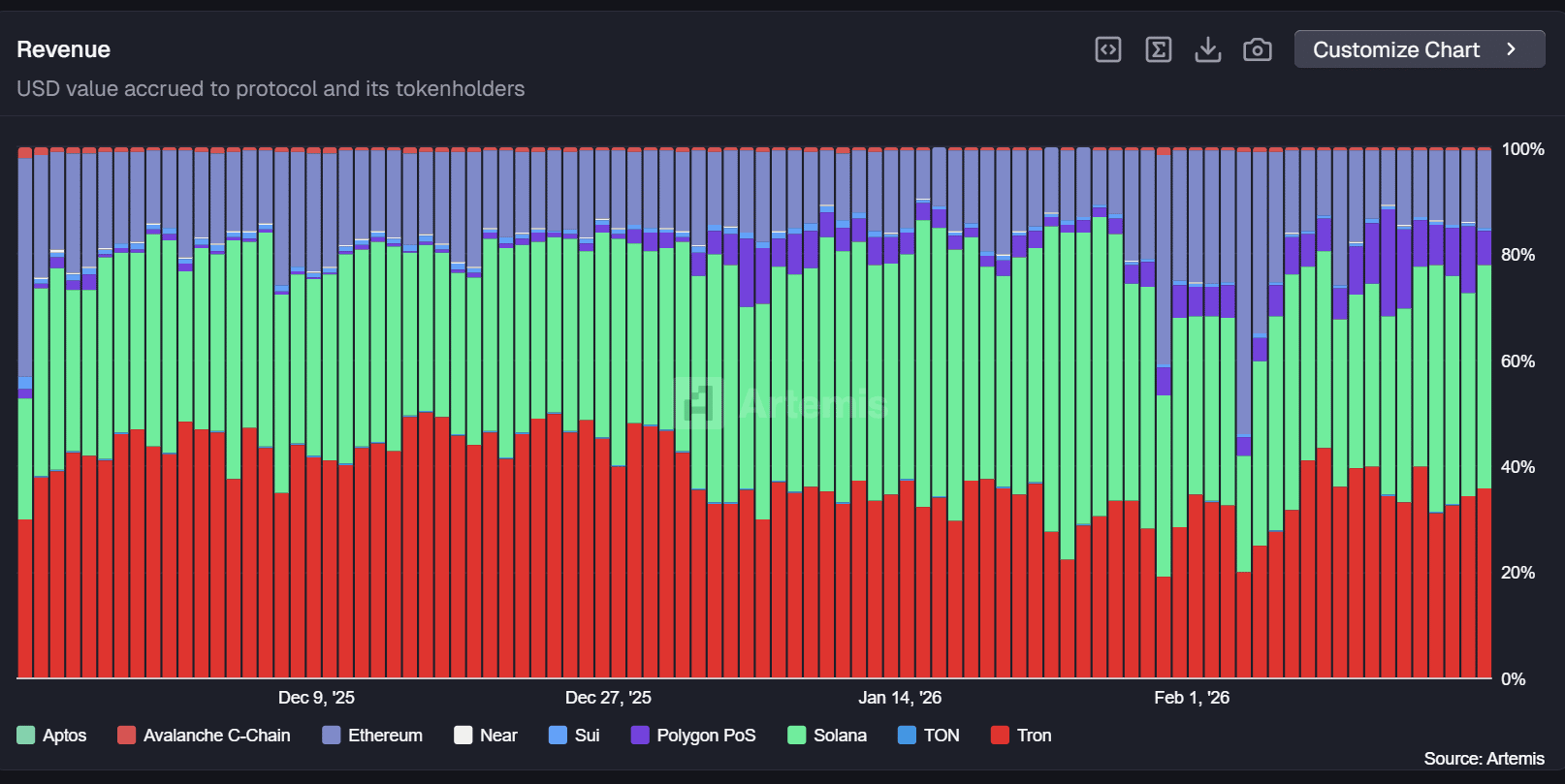
Despite the positive news, SOL has traded near US $86 and price action has been muted, with Ethereum still holding 73.74% of PYUSD supply on-chain compared to Solana's 20.76%, per DeFiLlama. US-listed Solana investment products recorded six consecutive days of inflows as of 19 February, bucking broader crypto outflow trends.
What this means for investors
PayPal's infrastructure decision is the kind of signal that tends to get underpriced in the short term. When a company processing payments for hundreds of millions of users makes a default blockchain choice, it is not a narrative statement - it is an engineering and cost decision, one that has compounding effects on developer activity, stablecoin supply growth, and fee revenue.
We maintain a bullish outlook on BTC, ETH and SOL.
Sources: The Coin Republic; DeFiLlama; Velora/X; ZyCrypto; CoinMarketCap (19 Feb 2026)
The SEC Just Changed The Rules
On 19 February 2026, the SEC's Division of Trading and Markets quietly updated its guidance to allow broker-dealers to apply only a 2% capital haircut on proprietary positions in qualifying payment stablecoins - down from the de facto 100% treatment that many institutions had been using out of caution.
Commissioner Hester Peirce endorsed the change, noting that compliant stablecoins backed by US Treasuries and cash equivalents are economically comparable to money market funds, which carry the same 2% haircut under existing capital rules.
Separately, the White House hosted its third mediation session on 19-20 February between banks and crypto firms over stablecoin yield provisions in the CLARITY Act, setting a March 1 deadline for a compromise.
Polymarket currently prices a 78% probability of the CLARITY Act passing in 2026, with Ripple CEO Brad Garlinghouse citing 90% odds of passage by April. The sticking point remains whether stablecoin issuers and affiliated platforms can offer yield to holders, with banks arguing this threatens their deposit base and crypto firms countering that the competitive concern outweighs any systemic risk.

What this means for investors
The practical significance of the SEC's haircut change is substantial. Under the old regime, holding US $1 million in stablecoins required US $1 million in offsetting capital - making stablecoin inventory economically punitive for broker-dealers. At 2%, that same holding requires only US $20,000 in capital. This removes a structural impediment that has kept traditional financial firms on the sidelines of on-chain markets, and could accelerate their participation in tokenised securities settlement, digital asset custody, and payments infrastructure.
Sources: SEC.gov (Commissioner Peirce statement, 19 Feb 2026); CoinDesk; The Block; Polymarket; BeInCrypto; DeFiRate
Until next week,
James
Sign up to receive the latest crypto trends, insights, and news.
.png)